LU Factorization

LU Factorization |
|
Under certain conditions the system matrix A of the equation Ax = b can be expressed in the form of a product of a unit lower triangular matrix L with units on the main diagonal and an upper triangular matrix U,and as the result, one has to solve two systems with triangular matrices.
LU Factorization computes matrices L and U such that
A = L * U
where A is a real, double-precision square matrix, L is a matrix with the same type and dimension as A, and U is an upper triangular matrix with the same type and dimension as A.
L U = A ................... (
I )
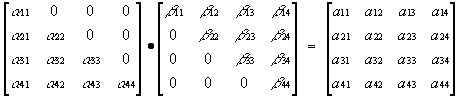 ...................
( II )
...................
( II )
This is same as,

 ...................... ( III )
by first solving for vector y such that,
 ..................... ( IV )
and then solving,
 .................
( V )
.................
( V )

 .....................
( VI )
.....................
( VI )
while (3.2.4.5) can be solved by back substitution as follows,

 ....................
( VII )
....................
( VII )
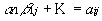
The number of terms in the sum depends on whether i or j is the smaller number. There are 3 cases,
 ..................
( VIII )
..................
( VIII )
 ..................
( IX )
..................
( IX )
 ..................
( X )
..................
( X )
Equations ( VIII ) – ( X ) total N2
equations for the N2 + N unknown  ’s
and
’s
and  ’s (diagonal
represented twice). Since the number of unknowns is greater than the number
of equations, N number of unknowns can be specified
arbitrarily and used to solve the others. It is always possible to take,
’s (diagonal
represented twice). Since the number of unknowns is greater than the number
of equations, N number of unknowns can be specified
arbitrarily and used to solve the others. It is always possible to take,
 ..................... ( XI )
Now, using Crout’s algorithm, all the ’s
and ’s can be solved
by arranging the equations in a certain order. That order is as follows,
 (equation XI )
 do the following 2 procedures:
 ,
use equations VIII and IX to solve for
,
use equations VIII and IX to solve for 
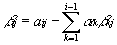 .......................
( XII )
.......................
( XII )
 ,
use equation X to solve for
,
use equation X to solve for 
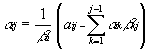 ........................ ( XIII )
By working on a few iterations of the above procedure, it
can be seen that ’s
and ’s that occur on
the right-hand size of equations ( XII ) and ( XIII ) are already determined
by the time they are needed. In brief, Crout’s algorithm
fills in the combined matrix of ’s
and ’s.
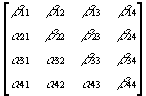 ............................... ( XIV )
det = 
The class os_lufact is a templatized implementation of LU factorization. The following is abrief description of the LU factorization/decomposition technique. The following example code shows how to use various methods supported by the os_lufact class.
#include <ospace/math.h>


int
main()
  {
  os_math_toolkit math_init;

  double mat_data[ 5 ][ 5 ] =
    {
    { 0, 1, 2, 3, 4 },
    { 5, 6, 7, 8, 9 },
    { 1, 2, 3, 4, 5 },
    { 6, 7, 8, 9, 1 },
    { 2, 3, 4, 5, 6 }
    };

  double vec_data[ 5 ] = { 1, 2, 1, 3, 4 };

  os_num_matrix< double > matrix( 5, 5 );
  os_num_vector< double > vec( 5 );

  for ( int i = 0; i < 5; i++ )
    {
    for ( int j = 0; j < 5; j++ )
      {
      matrix( i, j ) = mat_data[ i ][ j ];
      }
    vec[ i ] = vec_data[ i ];
    }

  os_lufact< double > lufact( matrix );

  cout << "factorized = \n" << lufact.factorized_matrix() << endl;
  cout << "determinant = " << lufact.determinant() << "\n" << endl;
  cout << "inverse = \n" << lufact.inverse() << endl;
  cout << "solve = \n" << lufact.solve( vec ) << endl;


  return 0;
  }
Copyright©1994-2013 Recursion
Software LLC
All Rights Reserved - For use by licensed users only.