Data Exchange and Synchronization

Data Exchange and Synchronization |
|
When communicating with the Universal Streaming Service (USS), a protocol handshake must occur before data transmission can begin. The reader and writer exchange platform-specific information using a USS format label. USS format labels describe the architecture of both platforms, including the size of each native data type. This information is critical when communicating between two dissimilar architectures, such as SPARC and Intel.
Although USS format labels are
automatically managed by the os_bstream class, the
presence of the labels must be synchronized between both parties. Consequently,
binary streams are subject to the following rules.
os_bstream
and write to it for the first time, a format label is automatically sent
first. After the first write, no additional format labels are sent unless
you reset the os_bstream using reset()
.os_bstream
and read from it for the first time, a format label is expected first. After
the first read, the os_bstream saves the format
of the writer, and will not expect another format label unless you first
reset the os_bstream using reset()
. In most cases, automatic format
label management is not a problem. However, because this mechanism is tied to
the construction of an os_bstream object, you must
follow a simple rule to ensure that your stream ends are synchronized.
os_bstream and
writer os_bstream must be consistent.
For example, if you construct a
single os_bstream and write three objects to it,
construct a single os_bstream and read three
objects from it. Do not construct three os_bstream
objects and read one object from each.
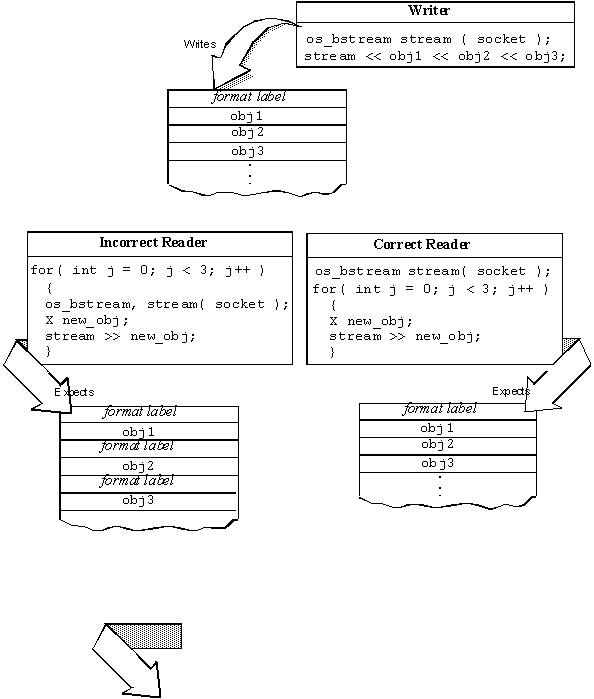
The following diagram illustrates
the effect of inconsistent scope when using os_bstream
objects. The writer constructs a single os_bstream
and writes three X objects to it. If the reader
constructs an os_bstream in a loop and reads one X
object per loop iteration, as shown in the incorrect reader example below, the
reader expects a format label three times. Instead, construct the reader to use
a single os_bstream for all iterations of the loop,
as shown in the correct reader example below.
Often, a protocol adapter must maintain its own state information to correctly translate between the encoded data representation and the native machine format. For instance, most protocols share the concept of memory alignment, which can force extra padding between data values. To ensure the correct amount of padding is written, the protocol adapter must remember the last data type written to the stream.
To accommodate the need for state information in protocol adapters, follow these simple rules to ensure this state is managed correctly.
os_bstream objects
connected to the same device at the same time. This technique circumvents the
state information maintained in the protocol adapter, thus corrupting the final
data stream.
RULE-If you seek on a
device, the os_bstream object connected to the
device is no longer valid. Construct a new os_bstream
on the device, or reset the os_bstream objects
using reset() , before reading or writing. This
causes a new format synchronization.
os_bstream .
Copyright©1994-2026 Recursion
Software LLC
All Rights Reserved - For use by licensed users only.